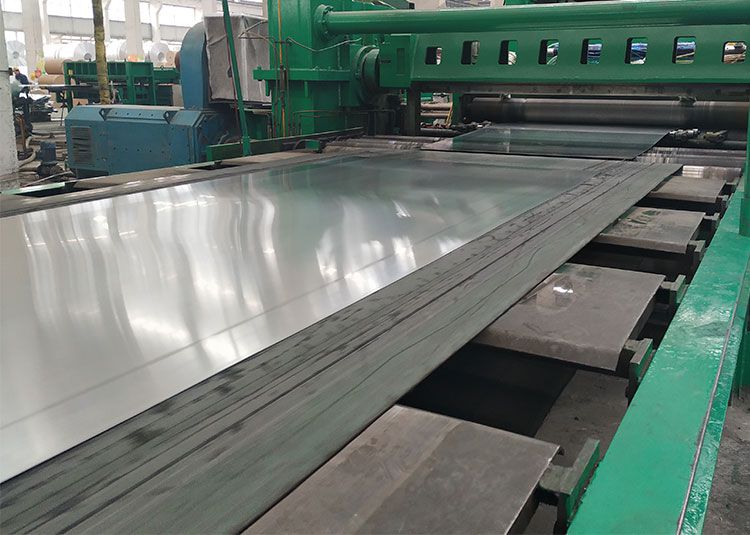

Aluminium Alloy Plate for Marine 7055: A High-Strength Alternative Reimagining Ship Design
Marine designers have long been trapped in a compromise: choose ultra-high strength aluminium and sacrifice corrosion resistance and weldability, or prioritize marine durability and accept a lower strength ceiling. Aluminium alloy plate for marine 7055 enters this conversation from a different angle. Instead of being “just another 7xxx alloy,” 7055 offers a way to re-balance the design equation: extreme strength, finely tuned tempering, and controlled microstructure management all leveraged for marine environments where weight, stiffness and fatigue life are mission-critical.
Why 7055 Aluminium Makes Sense in a Marine World
Traditionally, marine aluminium standards focus on 5xxx (Al–Mg) and 6xxx (Al–Mg–Si) alloys for plate used in hulls and superstructures. They offer excellent corrosion resistance and decent weldability, but they impose a performance ceiling in terms of tensile strength and stiffness.
Alloy 7055 belongs to the high-strength 7xxx family (Al–Zn–Mg–Cu). It was originally engineered for aerospace, especially for thick-section plate in high-load structures such as wing spars. This aerospace origin is precisely what makes 7055 so attractive for marine plate when used thoughtfully: it allows naval architects and marine engineers to import aerospace-style structural efficiency into hull, deck, and high-load marine components.
Core Technical Characteristics of Marine 7055 Plate
Although marine 7055 is a specialized application, its core metallurgical behavior follows that of a classic high-strength Al–Zn–Mg–Cu alloy, where mechanical performance springs from a very specific precipitation-hardening sequence. The design goal: an ultrafine dispersion of eta-phase precipitates (MgZn₂ and related phases) that maximize strength without unacceptably degrading toughness and stress-corrosion resistance.
property trends for marine aluminium alloy plate 7055 include:
- Extremely high tensile and yield strength, especially in T77 and T76x tempers
- High stiffness-to-weight ratio, enabling thinner sections for the same load
- Good fatigue resistance when surface and stress concentration are properly controlled
- Sensitive but manageable corrosion behavior in chloride-rich marine environments, provided surface protection and design details are handled correctly
Typical Chemical Composition of 7055 Marine Aluminium Plate
The chemical balance of 7055 is heavily weighted toward zinc and magnesium, with copper used to tune strengthening and thermal stability. Chromium, zirconium and other micro-alloying elements help refine grain structure and improve recrystallization control.
A typical chemical composition range for 7055 aluminium alloy plate is:
| Element | Typical Range (wt. %) |
|---|---|
| Zinc (Zn) | 7.6 – 8.4 |
| Magnesium (Mg) | 1.8 – 2.4 |
| Copper (Cu) | 2.0 – 2.6 |
| Zirconium (Zr) | 0.08 – 0.25 |
| Manganese (Mn) | ≤ 0.10 |
| Chromium (Cr) | ≤ 0.04 |
| Iron (Fe) | ≤ 0.15 |
| Silicon (Si) | ≤ 0.10 |
| Titanium (Ti) | ≤ 0.06 |
| Others, each | ≤ 0.05 |
| Others, total | ≤ 0.15 |
| Aluminium (Al) | Balance |
From a marine engineering perspective, the Zn–Mg–Cu triad defines both the opportunity and the challenge. High solute content means very high potential strength through precipitation hardening, but also a higher sensitivity to stress-corrosion cracking if tempering and residual stress are not controlled. This is where marine-grade 7055 moves away from purely aerospace thinking and leans into a more nuanced balance of strength vs. environment.
Mechanical Properties and Density: Structural Efficiency in Practice
When converted for marine plate use, 7055 can deliver strength levels that compete with conventional steels at about one-third of the density. Designers can:
- Reduce plate thickness for weight savings while maintaining safety factors
- Increase stiffness for high-speed vessels where slamming loads and dynamic responses govern
- Optimize local reinforcements and frames instead of overbuilding entire hull sections
Typical mechanical properties for 7055 plate in high-strength tempers (values are indicative and vary by thickness and temper) are:
| Property | Typical Value* |
|---|---|
| Density | ~ 2.83 g/cm³ |
| Tensile Strength (Rm) | 540 – 655 MPa (T77 range, thickness-dependent) |
| Yield Strength (Rp0.2) | 480 – 600 MPa |
| Elongation (A50) | ~ 7 – 13 % |
| Modulus of Elasticity | ~ 71 GPa |
| Brinell Hardness | ~ 170 – 190 HB |
*Actual values depend on plate thickness, temper (e.g., T77, T7651), and processing route.
The unique viewpoint here is not just “high strength numbers,” but how those numbers reshape marine design logic. In a high-speed patrol craft or an aluminum-intensive offshore superstructure, every kilogram saved is extra payload capacity, more fuel efficiency, or additional range. 7055 brings a level of structural headroom that allows engineers to redesign entire load paths, not only individual plates.
Alloy Tempering: How Heat Treatment Designs the Microstructure
7055 is not a single material in practice; it is a family of microstructures controlled by tempering. The temper is where the alloy’s internal architecture is written. For marine applications, this architecture must reconcile high static strength, adequate toughness, and acceptable corrosion resistance.
Common tempers for 7055 plate that are of particular interest in marine structures include:
T6
Solution heat-treated and artificially aged for maximum strength. Delivers very high tensile and yield strength but can be more prone to stress-corrosion cracking. Typically reserved for non-critical or well-protected components offshore, or where inspection and maintenance regimes are very robust.T77
A more advanced, over-aged-type temper specifically engineered to improve resistance to stress-corrosion cracking (SCC) and exfoliation corrosion while retaining high strength. For marine 7055 plate, this temper is frequently favored because it hits a balanced point: excellent structural performance with enhanced environmental robustness.T7651
Solution heat-treated, stress-relieved by stretching, then over-aged. The stress-relief step is essential for thick plate used in marine frames, bulkheads, and high-load mounting platforms. Reduced residual stress helps minimize distortion during machining and improves dimensional stability and fatigue behavior.
From the viewpoint of a marine designer, choosing a temper is equivalent to choosing a performance strategy. T6 is like a sprint setting: high strength, less forgiving. T77 and T7651 are endurance modes, tailored for the long-term battle against saltwater, cyclic waves, and thermal cycles.
Implementation Standards and Classification Context
While 7055 is fundamentally an aerospace-grade alloy, its marine use is being structured under an increasingly strict framework of standards and classification requirements. Typical references and influences in implementation include:
- International standards such as EN / EN 485 series and ISO 6362-type documents for wrought aluminium products, adapted for high-strength 7xxx plates
- Mill internal specifications for 7055 chemistry, ultrasonic inspection, and mechanical properties by thickness
- Customer-specific or project-specific standards for corrosion testing, fatigue performance, and fracture toughness
- Classification society rules, where marine plate in high-load zones must satisfy guidelines from organizations such as DNV, ABS, Lloyd’s Register, BV, and CCS for:
– minimum yield and tensile strength
– notch toughness where applicable
– corrosion protection system compatibility (painting, anodizing, sealing, cathodic protection)
Although 7055 might not yet be as widely codified as 5xxx or 6xxx alloys in the marine rulebooks, forward-looking shipyards and offshore fabricators are already aligning their internal standards: pairing mill certificates with finite element simulations and full-scale fatigue tests to validate plate performance for particular hull forms and structures.
Corrosion Behavior: Turning a High-Strength Alloy into a Marine Asset
High-strength 7xxx alloys come with a reputation: as strength rises, the battle against localized corrosion and SCC becomes more intense. However, the modern of 7055, combined with well-configured tempering and design, allows it to be used successfully in marine environments when handled correctly.
considerations in corrosion and surface performance of marine 7055 include:
Precipitation control
The T77 and T7651 tempers are specifically designed to manage the size, distribution and interface characteristics of η-phase precipitates at grain boundaries and within the matrix. By moderating peak strength very slightly, these tempers drastically improve SCC and exfoliation resistance over classic T6.Surface treatments
Anodizing, conversion coatings and multilayer marine paint systems are not optional extras; they are integral design components. 7055 plate responds well to carefully controlled anodizing processes that avoid excessive dissolution at grain boundaries. High performance epoxy- or polyurethane-based marine coatings provide a durable barrier against salt spray, immersion and cyclic wet–dry exposure.Design details
Sharp corners, unsealed lap joints, and regions where stagnant seawater can sit will always be corrosion accelerators, regardless of the alloy. When 7055 is used, attention to drainage, sealing, and avoidance of crevices is mandatory. Proper isolation from dissimilar metals via insulating washers, sealants and coatings minimizes galvanic coupling.
From a unique standpoint, you can think of 7055 as a “microstructure-sensitive” alloy. Its marine success is as much about how you design, join, seal and coat it as about its inherent composition.
Machinability, Forming and Joining in Marine Construction
High-strength often suggests “difficult to work with.” 7055 breaks that stereotype in interesting ways, particularly for precision marine applications such as hydrofoil struts, high-load brackets, radar mast bases and superstructure plates.
Machinability
7055 offers good machinability for high-speed milling and drilling, producing short chips and relatively clean surfaces. For marine component manufacturers, this means thinner tolerances on large plate-derived structures, such as integrated girders, stiffened panels and mounting plates for propulsion or steering systems.Formability
While not as formable as softer 5xxx alloys, 7055 plate in solution-treated or partially aged conditions can be formed into moderate curvatures with well-designed tooling and proper radii. For double-curved ship hull plating, 7055 is generally used in regions that can be approximated by gently bent sections or machined panels, rather than extreme stretching.Welding and joining
Fusion welding of 7xxx alloys is always a nuanced topic. 7055 is typically not used where extensive fusion welding is required in the primary load path. Instead, designers emphasize:
– Mechanical fastening (bolted, riveted, tensioned fasteners with isolation where needed)
– Friction stir welding (FSW) under carefully controlled parameters, which can mitigate much of the loss in strength across the joint region and reduce defects
– Hybrid construction, where 5xxx or 6xxx plates are used in heavily welded portions, while 7055 plates are used as bolted or FSW-connected high-strength inserts, bulkhead flanges, or reinforcement plates
A creative but robust approach is to treat 7055 as a “strategic alloy”: concentrate it where strength and stiffness dominate, and pair it with more weldable marine alloys elsewhere.
Typical Parameter Window for Heat Treatment and Processing
Because the marine behavior of 7055 is microstructure-driven, heat treatment parameters are not just production details; they are performance levers.
A generalized process route for marine 7055 plate might include:
Solution heat treatment
Conducted typically in the range of about 470 – 480 °C, ensuring complete dissolution of soluble phases without incipient melting. Soak time is adjusted to thickness, allowing homogeneous solute distribution.Quenching
Rapid quenching in controlled water or polymer quench media to suppress premature precipitation. For marine applications, residual stress control is important to minimize distortion of large plates during machining or assembly.Stretching (for –51 tempers)
A controlled permanent elongation (around 1.5 – 3 %) introduces plastic strain that relieves internal stresses, stabilizing the plate and reducing warp and twist.Artificial aging
Multi-step ageing schedules for T77 and T7651 are applied in the 120 – 160 °C region, sometimes in two or more stages, to sculpt the balance between intragranular and grain-boundary precipitates. The goal is a microstructure that is strong yet not excessively prone to intergranular attack or SCC.
These parameters vary among producers and are often proprietary, but the principle stays constant: for marine 7055 plate, the heat treatment is carefully skewed towards a corrosion-conscious overaged or specially aged condition rather than simply chasing the highest possible tensile strength.
Application Scenarios: Where Marine 7055 Plate Changes the Rules
In practice, aluminium alloy plate 7055 for marine use shines in high-demand structures where weight and stiffness margins drive the overall design:
- High-speed patrol boats and fast ferries, particularly in high-stress deck and superstructure zones
- Offshore support vessels, where large, cantilevered structures and heavy equipment mounts benefit from high-strength plate
- Aluminum-intensive yacht and superyacht structures targeting aggressive weight reduction while maintaining luxury comfort (reduced vibration, controlled deflection)
- Naval vessels pursuing signature reduction, high maneuverability and rapid deployment, where lighter topside structures improve stability and enable heavier mission systems
- Advanced marine equipment such as foil supports, thruster mounts, radar towers and mission module interfaces, where plate must withstand localized, high-static and dynamic loads
The competitive edge is not merely lower weight; it is improved structural efficiency. A structure built with 7055 can be both lighter and stiffer, and when integrated with smart protective coatings and thoughtful joint design, it retains that advantage throughout its service life.
A Distinctive View: 7055 as a Marine Design Strategy, Not Just a Material
Aluminium alloy plate for marine 7055 is not a plug-and-play substitute for traditional marine alloys. It is an enabler of a new design strategy:
- Use material science—particularly tempering and microstructural tailoring—to unlock strength and durability simultaneously.
- Shift the mindset from “overbuilding with soft alloys” to “precision engineering with high-strength plate.”
- Combine aerospace-derived plate performance with marine-specific protection and detailing.
When approached this way, 7055 is not simply a high-strength aluminium; it becomes a bridge between two worlds. It carries the lessons of aerospace metallurgy into shipyards, offering marine engineers a new way to solve old problems: lighter ships that go farther, faster, and carry more, without abandoning the protection needed in corrosive, wave-battered environments.
For shipbuilders, offshore fabricators and marine equipment designers seeking a competitive, weight-focused edge, marine 7055 aluminium alloy plate is more than a material choice. It is a deliberate, technically sophisticated design decision that reshapes how metal is used above and at the waterline.